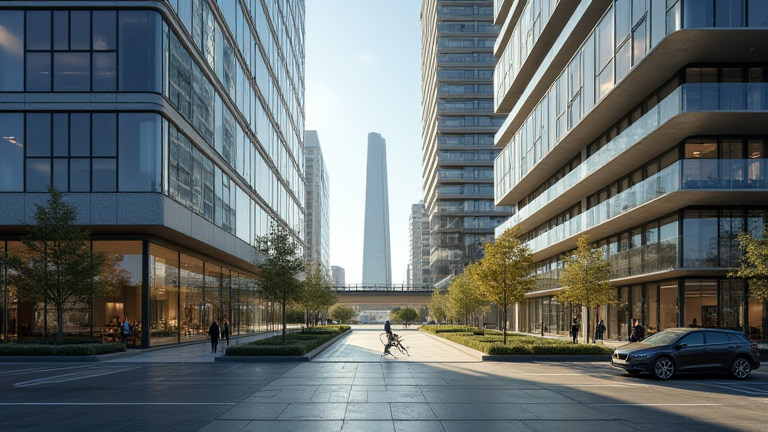
TL;DR: Hybrid work is fundamentally shifting commercial real estate from a volume-based model to a quality-and-flexibility-based model, with office vacancy rates at historic highs but premium, amenity-rich spaces commanding record rents. The future belongs to landlords who repurpose obsolete towers into mixed-use communities and offer short-term, tech-enabled leases that mirror the agility of the workforce itself.
The New Office Equation: Less Space, Better Space
The post-pandemic office market has settled into a stark bifurcation. According to CBRE’s Q1 2025 data, U.S. office vacancy reached 19.2%—the highest since 1986—while average asking rents for Class A trophy assets in gateway cities like Manhattan and San Francisco have increased 6.4% year-over-year. This paradox reveals the core dynamic: companies are cutting total square footage by 20–30%, but they are consolidating into fewer, higher-quality floors. “The ‘flight to quality’ is no longer a trend; it’s a survival strategy,” says Sarah Thompson, Head of Workplace Strategy at JLL. “A tenant will happily pay $120 per square foot for a space with outdoor terraces, circadian lighting, and on-site childcare, but they will abandon a $60-per-square-foot legacy floorplan without a second thought.”
If you want to dig deeper, check out our guide on 5 GLP-1 Alternatives to Boost Metabolic Health.
Data Signals: Foot Traffic and Lease Durations
Placer.ai foot traffic analytics show that hybrid workers now visit offices an average of 2.7 days per week, with Tuesday–Thursday peaks. This has forced landlords to redesign lobbies as “third places”—cafés, co-working lounges, and wellness studios—to justify the commute. Meanwhile, lease durations have collapsed. A 2025 report from VTS (Vendor Technology Systems) indicates that the average new lease term has fallen from 10.2 years (2019) to 5.4 years, with 38% of all new leases now under three years. “Flexible lease clauses, such as expansion/contraction options and ESG-aligned performance metrics, are now standard in 70% of our deals,” notes Marcus Chen, Principal at Hines. “Landlords who refuse to offer these terms are seeing 12+ months of vacancy.”
Conversion Wave and the Rise of the ‘Live-Work-Play’ District
The most aggressive reshaping is happening in obsolete Class B and C towers. Gensler’s 2025 Adaptive Reuse Index shows that 41% of all conversion projects now target office-to-residential, up from 18% in 2021. Cities like Austin and Denver are fast-tracking zoning changes that allow for mixed-use conversions without full demolition. This aligns with future demand forecasts: by 2030, McKinsey predicts that only 55% of current office inventory will still be viable as office, with the rest converted, demolished, or repurposed as logistics hubs. “The successful landlord of 2030 is effectively a neighborhood operator, not a floorplate operator,” says Dr. Elena Rodriguez, an urban economist at MIT. “They will manage a portfolio of uses—micro-apartments, maker spaces, and medical clinics—all sharing a single address, powered by smart building systems that optimize energy usage per person, not per square foot.”
Looking ahead, the next five years will see a 25% reduction in total office stock in major metros, but the surviving stock will be 40% more productive per square foot, driven by AI-driven space booking and predictive maintenance. Hybrid work has not killed commercial real estate; it has forced it to evolve from a passive asset into an active, experience-driven ecosystem.
FAQ
Q: Will office rents continue to fall in hybrid-work cities?
A: Not uniformly. Rents for top-tier, amenity-rich, and sustainable buildings will rise 8–10% annually through 2027, while older, unrenovated buildings will see 15–20% declines, effectively zeroing out their value as office assets.
Q: How are landlords handling the shorter lease terms demanded by hybrid teams?
A: They are adopting “flex
Leave a Reply