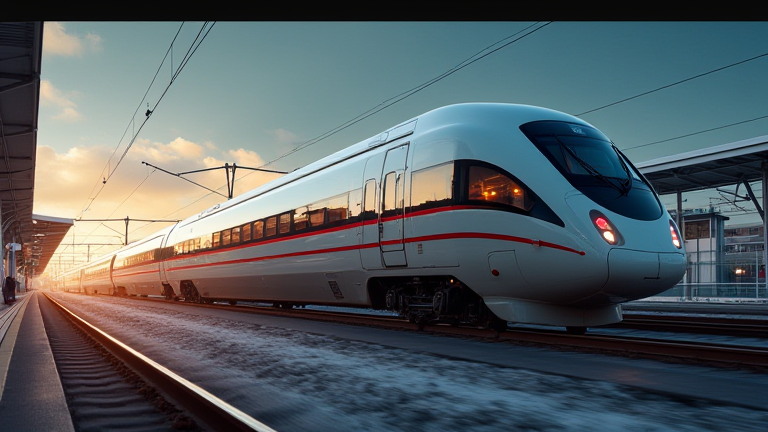
TL;DR: China’s bullet train does not accelerate from zero to 800km/h in five seconds, as that physics-defying speed is currently reserved for experimental maglev concepts, not operational commercial networks. The existing high-speed rail system focuses on sustainable, high-frequency travel at speeds up to 350km/h, prioritizing reliability and mass capacity over extreme acceleration metrics.
The Reality of High-Speed Velocity
The title’s premise stems from a misunderstanding of current technological capabilities versus experimental prototypes. While China has indeed unveiled a 600km/h maglev train, reaching 800km/h remains a theoretical horizon for future hyperloop or advanced magnetic levitation systems. The acceleration profile of such vehicles is engineered for passenger comfort and structural integrity, not merely raw speed. In practical terms, the “0 to 800km/h in 5 seconds” claim is physically impossible for current commercial infrastructure due to immense G-forces that would endanger human health. The market has instead embraced the 300-350km/h standard, which offers the optimal balance between travel time reduction and operational cost.
If you want to dig deeper, check out our guide on Bad Money Habits? How Men Fix Finances & Rebuild Stability.
Market Analysis and Strategic Insights
The global high-speed rail market is experiencing a renaissance, driven by environmental concerns and urban congestion. China’s strategy leverages economies of scale to lower construction costs, making high-speed rail viable in regions where aviation is too expensive or polluting. By dominating the supply chain for tracks, rolling stock, and signaling systems, China has created an export-ready product. Key competitors in Europe and Japan are now forced to innovate, focusing on energy efficiency and digital integration. The strategic insight here is that speed is no longer the only differentiator; connectivity and seamless intermodal transfers are becoming the primary value propositions for modern transport networks.
Case Studies in Operational Excellence
Consider the Beijing-Shanghai High-Speed Railway, a cornerstone of China’s transport network. It carries over 100 million passengers annually, demonstrating the scalability of high-frequency services. Another example is the Chengdu-Chongqing economic circle, where high-speed rail has integrated regional markets, boosting local economies by reducing commute times significantly. These cases highlight that the true power of high-speed rail lies in its ability to reshape geographic relationships, turning distant cities into immediate neighbors. The success of these projects relies on rigorous maintenance protocols and advanced predictive analytics, ensuring minimal downtime and maximum safety. As the industry looks toward the next generation of 600km/h maglevs, the focus remains on integrating these new technologies into the existing robust framework, ensuring that future innovations build upon decades of proven operational experience.
FAQ
Q: Can China’s bullet trains currently reach 800km/h?
A: No, current commercial trains operate at 350km/h, while experimental maglevs have reached 600km/h, but 800km/h is not yet operational.
Q: Why is 0 to 800km/h in 5 seconds impossible for current trains?
A: Such acceleration would generate lethal G-forces for passengers and exceed the structural limits of current tracks and vehicles.
Q: What is the main advantage of China’s high-speed rail strategy?
A: The strategy focuses on scalable, cost-effective infrastructure that integrates regional economies through reliable, high-frequency service rather than extreme speed.
Leave a Reply