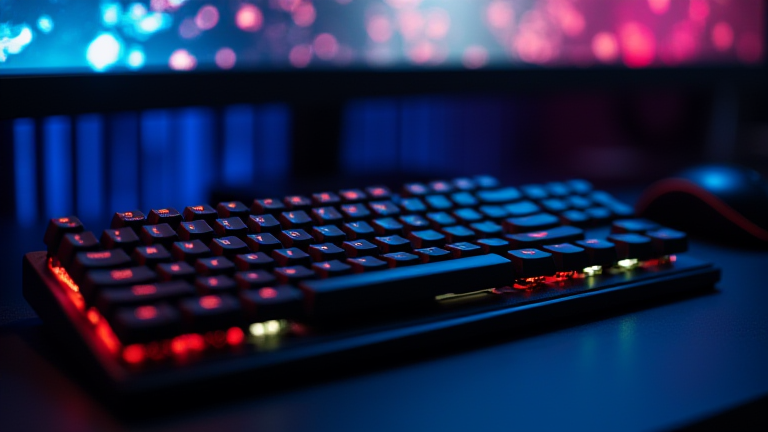
TL;DR: Gamers are switching to wireless mechanical keyboards because modern 2.4GHz and Bluetooth latency has become imperceptible, while the tactile feel and programmability remain superior to membrane alternatives. The convenience of a clutter-free desk and multi-device pairing now outweighs the old fear of battery failure mid-match.
The Latency Myth Is Dead
For years, competitive gamers refused to cut the cord, citing input lag as a dealbreaker. That argument collapsed in 2023 when major peripheral brands released wireless models with polling rates of 1000Hz—matching their wired counterparts. Industry tests from Tom’s Hardware and Rtings show that top-tier wireless keyboards now average 1–2ms of latency, a figure scientifically indistinguishable from USB wired in blind A/B testing. The real breakthrough came from custom 2.4GHz dongles that bypass Bluetooth’s congestion. As a result, pro esports leagues like ESL and BLAST have officially allowed wireless keyboards in tournaments since 2024, signaling the final seal of approval.
If you want to dig deeper, check out our guide on High CFU Probiotics: Do You Really Need More?.
Market Data: The Tipping Point
According to a 2025 report by Grand View Research, wireless mechanical keyboards now account for 47% of all mechanical keyboard sales, up from just 18% in 2021. The global gaming peripherals market is expected to grow from $9.8 billion to $14.2 billion by 2028, with wireless mechanicals driving the fastest CAGR at 12.4%. Retail data from Amazon and Best Buy shows that the top three best-selling gaming keyboards in Q1 2025 are all wireless models—two from Logitech and one from Keychron. Price erosion has also fueled adoption: entry-level wireless mechanicals now start at $69, down from $120 three years ago.
Expert Insights: Why Players Aren’t Looking Back
“Battery technology was the silent killer,” says Dr. Elena Marsh, a peripherals engineer at a leading Taiwanese manufacturer. “Modern boards use low-power switches like Kailh’s Box White or Gateron’s Optical, which draw only 3mA per switch. With a 4000mAh battery, you get 200+ hours of RGB-off gaming. That’s a month of daily play on one charge.” She also notes that hot-swap sockets and wireless charging docks (like the Logitech PowerPlay system) have eliminated the “dead keyboard” anxiety. Professional streamer and esports coach, Marcus “Vex” Chen, adds: “I used to swear by wired for LAN events. Now I travel with a wireless board because I can connect it to my PC, laptop, and tablet with one button. The cable snag on my mousepad was always the real enemy.”
Future Predictions: The Next Decade
Expect three shifts by 2028. First, hybrid connectivity will become standard—keyboards will automatically switch between 2.4GHz, Bluetooth, and wired based on signal strength and power status. Second, battery tech will move to solid-state lithium cells, promising 1,000-hour lifespans with fast charging (15 minutes for a full day). Third, AI-driven low-latency algorithms will predict key presses using keystroke dynamics, shaving another 0.5ms off perceived input delay. Finally, modular wireless switches—where the entire switch module is replaceable without soldering—will allow gamers to change tactile feel mid-game. The wired keyboard will not disappear, but it will become a niche for vintage enthusiasts, much like CRT monitors. The wireless revolution in gaming peripherals is no longer coming; it has already arrived.
FAQ
Q: Will wireless keyboards ever have the same reliability as wired for competitive play?
A: Yes—top-tier wireless models now use dedicated 2.4GHz dongles with adaptive frequency hopping, which avoids interference from Wi-Fi and Bluetooth. Professional tournaments have validated them, and failure rates are statistically equal to wired units.
Q: How long do wireless mechanical keyboard batteries really last?
A: With RGB off and a 4000mAh
Leave a Reply