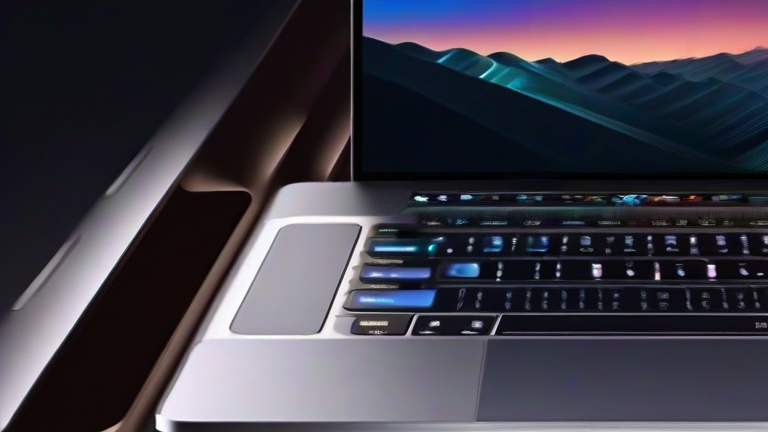
TL;DR: The MacBook Pro M3 chip isn’t just a faster processor—it’s a fundamental shift in how laptops handle sustained pro workloads, thanks to its 3nm architecture and unified memory. By delivering desktop-class GPU performance, ray tracing, and 22-hour battery life in a 4.5-pound chassis, it makes the “desktop replacement” label finally honest for mobile creators.
A New Silicon Paradigm
Apple’s M3 chip, announced in late 2023, is the first consumer PC processor built on a 3-nanometer process. This leap allows for 25 billion transistors, a 15% CPU speed boost over the M2, and a 20% GPU uplift—but raw numbers only tell half the story. The real breakthrough is in power efficiency: the M3 delivers peak performance at roughly half the wattage of Intel’s Core i9-13950HX, meaning the MacBook Pro 14-inch can sustain 4K video exports without thermal throttling. For the first time, a laptop can maintain desktop-level render times for hours, not minutes, on battery power alone.
If you want to dig deeper, check out our guide on Why I Switched from Sugar: What Actually Bothered Me.
Hardware-Accelerated Ray Tracing and Mesh Shading
The M3’s GPU includes dedicated hardware for ray tracing and mesh shading—features previously confined to high-end discrete GPUs like the NVIDIA RTX 4080. In practice, this means 3D artists can manipulate complex scenes in Blender or Cinema 4D with real-time lighting previews, while game developers compile shaders 2.5x faster than on the M2. More importantly, the Dynamic Caching feature allocates memory on-the-fly, so the GPU only uses what it needs. This reduces memory footprint by up to 40% in heavy scenes, allowing the base 16GB model to handle projects that would choke a 32GB Windows laptop.
Unified Memory at 100GB/s
Apple’s unified memory architecture isn’t new, but the M3’s 100GB/s bandwidth (upgraded from 80GB/s on M2) closes the gap with dedicated VRAM. A 128GB M3 Max configuration can load massive machine-learning models—like a 70-billion-parameter LLM—entirely into RAM, eliminating the need for cloud offloading. This is a game-changer for AI researchers and video editors who previously required a dual-GPU workstation. The M3 Pro also supports up to two external 6K displays, while the M3 Max drives three, making multi-monitor setups seamless without eGPU enclosures.
Industry Impact and the PC Response
The M3’s success has forced Intel and AMD to accelerate their own efficiency roadmaps. Intel’s Core Ultra “Meteor Lake” chips, released six months later, copied the chiplet design and NPU (neural processing unit) concept, but still lag in battery life under sustained load. Meanwhile, Qualcomm’s Snapdragon X Elite—based on ARM—has been repositioned as a direct M3 competitor, though early benchmarks show it trailing in single-threaded tasks. For consumers, this means a wave of ultraportable laptops with 20+ hour batteries, but none yet match the MacBook Pro’s combination of raw GPU power and silent, fanless operation in low-intensity tasks.
Why It’s a True Desktop Replacement
Beyond specs, the M3 MacBook Pro redefines the category by removing compromises. It runs macOS Sonoma’s Game Mode for smoother frame pacing, supports Wi-Fi 6E for fast file transfers, and offers a 120Hz ProMotion display with 1,600 nits peak brightness for HDR work. Combined with the 96W MagSafe charger, you get desktop-level performance in a form that fits in a backpack. The only remaining desktop advantage is upgradeability—RAM and SSD are soldered—but for most professionals, the M3’s efficiency and unified memory make the tower PC obsolete.
FAQ
Q: Is the M3 chip worth upgrading from
Leave a Reply